Book Circulation Per U.S. Public Library User Since 1856
Douglas A. Galbi
Senior Economist
Federal Communications Commission[1]
July 29, 2007
Draft - Version 1.01
This paper is freely
available at www.galbithink.org/libraries/circulation.htm
(pdf version available on SSRN)
Comments and suggestions welcomed
More work on libraries
Digital forms and ubiquitous networks are greatly increasing opportunities to circulate authored symbolic works. Digitization projects are creating huge online libraries of digitized books that persons around the world can access at zero incremental cost. Storage prices are dropping so rapidly that one small device will soon be able to store all the music that most persons listen to throughout their lives. Video sharing sites are collecting and distributing large amounts of video across the Internet. Many persons can now easily create a huge library of digital works. How persons respond to vastly expanding access to works will significantly shape the communications industry.
To better understand the circulation of works, consider U.S. public-library users’ book borrowing behavior since the mid-nineteenth century. Measured relative to the unskilled wage, the dime novels that Irwin Beadle began selling in 1860 were almost five times more expensive than the twenty-five cent paperbacks being sold in 1950.[2] A lower real purchase price for books increased the incentive to purchase rather than borrow. Average time spent reading, according to the best available estimates, fell 50% from 1925 to 1995.[3] Less time spent reading implies less demand for borrowing books.
Other factors probably pushed toward more borrowing. The number of books in print, and the number of books in libraries, increased immensely from the mid-nineteenth century to the early twenty-first century.[4] Perhaps such a change encouraged persons to read a larger number of books less thoroughly, and hence favored borrowing books relative to purchasing books. Library users’ travel costs, in time and money, probably fell with improvements in transportation technology since the mid-nineteenth century. Lower travel costs reduce the total cost of borrowing books from a library.[5]
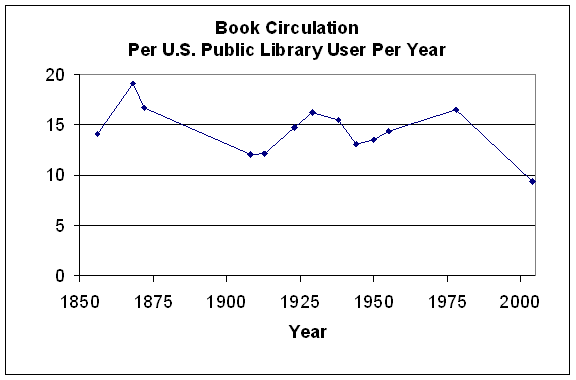
Library book circulation per user has no strong, long-run trend. From 1856 to 1978, library users borrowed from U.S. public libraries about 15 books per user per year. From 1978 to 2004, book circulation per user declined approximately 50%. The growth of audiovisuals circulation, estimated at 25% of total circulation in 2004, accounts for about half of this decline. These figures depend on estimates and disparate samples of libraries with varying circulation and user accounting methods. Nonetheless, these figures are of sufficient quality to suggest that historically established institutions significantly stabilize borrowing behavior.
I. Studies of Library Book Circulation
Statistics on library use are worth studying. Much data exists. Large individual libraries often issued annual reports that included statistical data on use of the library. In addition, since 1836 interested individuals, professional organizations, and government bodies have produced about 250 separate compilations of library statistics covering different dates and libraries. A leading library historian has observed:
Despite their value, little critical attention has been given by library historians to the purposes, methods, quality, and uses of the data.[6]
The data is not simple to analyze. One of the few scholars who has analyzed the data observed:
The writer did not find easy going in collecting and assembling this material. Gaps in reporting by individual libraries, lack of uniform standards in reporting, obvious misprints in tables, sporadic appearance of data, and frequent changes in the type of data reported are a few of the obstacles encountered.[7]
On the other hand, data encompassing large investments in communication across long periods of time are rare. Books require significant investments in writing and reading. Circulation of public library books is an important indicator of communication. Aggregate data on library use potentially offers important, long-run insights on communication.[8]
Circulation per user per year is a meaningful, feasible measure of library use across long periods. In this paper, circulation per user means borrowing for use outside the library per person who has affirmatively established the administrative right to borrow books from the library. Circulation per user indicates a significant type of individual behavior both in establishing an administrative relationship to a library and in using library materials. Total population, persons in libraries’ legal serving areas, and the number of persons who use libraries have risen over time. Circulation per user is conceptually distinct from these trends. Circulation per user is also conceptually distinct from changes in the distribution of library sizes and the scope and composition of the library sample.[9] Because circulation per user is a measure of average user behavior, it suggests user-weighted aggregation of library statistics. Sums of users and circulation across libraries implicitly is such an aggregation. Most importantly, sufficient data exist to estimate reasonably circulation per user since 1856.[10]
Kaiser’s study of large public libraries from 1908 to 1946 found that circulation per user did not change greatly.[11] This study collected data for all reporting public libraries in cities with population 200,000 persons or more.[12] The study also reported juvenile circulation for some years. Data reported to the American Library Association (ALA) in 1914 indicated that juvenile circulation per juvenile borrower was about 50% greater than adult circulation per adult borrower. This ratio and the juvenile circulation share series imply estimates for adult circulation per adult library user.[13] These estimates indicate that adult circulation per adult user was 13 in 1908, rose to 20 in 1930-33, and then fell to 14 in 1946 (see Table 1).
|
Table 1 Reported Public Library Circulation in U.S. Cities with Population 200,000 Persons or More
|
|||
|
Year |
Circulation. per User |
Percent Juvenile Circulation |
Adult Circulation per Adult User |
|
1908 |
15.4 |
38.0% |
13 |
|
1913 |
16.6 |
32.8% |
15 |
|
1921 |
15.5 |
34.1% |
14 |
|
1926 |
21.6 |
34.3% |
19 |
|
1930 |
22.8 |
35.3% |
20 |
|
1933 |
23.1 |
36.0% |
20 |
|
1937 |
21.1 |
36.9% |
19 |
|
1940 |
19.8 |
35.0% |
17 |
|
1943 |
16.4 |
40.9% |
14 |
|
1946 |
16.6 |
41.3% |
14 |
|
Source: Calculated from Kaiser (1948). |
|||
The Index of American Public Library Circulation provides annually from 1939 to 1983 circulation per person served.[14] These estimates were constructed from a representative sample of U.S. public libraries. The population that libraries serve, however, is larger than the number of registered library borrowers. Supporting data for the Index of American Public Library Circulation does not include the share of registered borrowers, but does include share of juvenile circulation.
The share of juvenile circulation is correlated with the share of juveniles in the population. In 1939, juveniles (persons ages 14 and under) were 25% of the population and juvenile circulation was 33% of total circulation. By 1957 these figures had risen to 30% and 51%, respectively. By 1980, with the passing of the post-World War II baby boom, juveniles had fallen to 22% of the population, and juvenile circulation had fallen to 31% of total circulation. Circulation per person served varies from 3.2 to 5.8 between 1939 and 1983 (see Table 2). A significant share of that variation is driven by the changes in the percentage of juvenile borrowers and juvenile’s higher borrowing per juvenile library user.
|
Table 2 Circulation from U.S. Public Libraries
|
||||
|
Year |
Total Public Library Circulation (1000s) |
Percent of U.S. Population Served |
Percent Juvenile Circulation |
Circulation per Person Served |
|
1939 |
415,924 |
60.4% |
33% |
5.3 |
|
1940 |
387,225 |
61.4% |
31% |
4.8 |
|
1941 |
358,526 |
62.5% |
34% |
4.3 |
|
1942 |
336,694 |
63.5% |
36% |
3.9 |
|
1943 |
333,365 |
64.6% |
36% |
3.8 |
|
1944 |
333,365 |
65.6% |
38% |
3.8 |
|
1945 |
333,365 |
66.6% |
38% |
3.8 |
|
1946 |
341,366 |
68.4% |
38% |
3.5 |
|
1947 |
342,602 |
70.2% |
42% |
3.4 |
|
1948 |
342,602 |
72.1% |
42% |
3.2 |
|
1949 |
376,529 |
73.9% |
45% |
3.4 |
|
1950 |
384,606 |
75.7% |
44% |
3.3 |
|
1951 |
392,683 |
74.7% |
44% |
3.4 |
|
1952 |
409,221 |
73.8% |
49% |
3.5 |
|
1953 |
429,175 |
72.8% |
49% |
3.7 |
|
1954 |
457,946 |
71.9% |
50% |
3.9 |
|
1955 |
474,426 |
71.0% |
50% |
4.0 |
|
1956 |
499,395 |
70.0% |
50% |
4.2 |
|
1957 |
515,876 |
70.4% |
51% |
4.3 |
|
1958 |
557,825 |
70.9% |
51% |
4.5 |
|
1959 |
582,795 |
71.3% |
50% |
4.6 |
|
1960 |
599,275 |
71.8% |
50% |
4.6 |
|
1961 |
632,735 |
72.2% |
49% |
4.8 |
|
1962 |
657,705 |
72.7% |
51% |
4.9 |
|
1963 |
657,705 |
73.1% |
50% |
4.8 |
|
1964 |
682,674 |
73.6% |
52% |
4.9 |
|
1965 |
761,849 |
74.0% |
51% |
5.3 |
|
1966 |
802,676 |
74.5% |
50% |
5.5 |
|
1967 |
822,319 |
74.9% |
50% |
5.6 |
|
1968 |
862,497 |
75.4% |
49% |
5.7 |
|
1969 |
883,033 |
75.8% |
44% |
5.8 |
|
1970 |
892,854 |
76.3% |
39% |
5.7 |
|
1971 |
923,211 |
76.7% |
37% |
5.8 |
|
1972 |
892,854 |
77.2% |
35% |
5.5 |
|
1973 |
883,033 |
77.6% |
34% |
5.4 |
|
1974 |
892,854 |
78.0% |
33% |
5.4 |
|
1975 |
979,940 |
81.0% |
34% |
5.6 |
|
1976 |
989,784 |
84.0% |
32% |
5.4 |
|
1977 |
986,715 |
87.0% |
32% |
5.2 |
|
1978 |
986,715 |
90.0% |
32% |
4.9 |
|
1979 |
966,981 |
93.0% |
31% |
4.6 |
|
1980 |
966,582 |
95.9% |
31% |
4.4 |
|
1981 |
1,037,037 |
96.0% |
30% |
4.7 |
|
1982 |
1,066,639 |
96.2% |
31% |
4.8 |
|
1983 |
1,070,000 |
96.4% |
32% |
4.8 |
|
Source: Goldhor (1985), Table 2. |
||||
|
Table 2b Circulation from U.S. Public Libraries |
||
|
Year |
Total Public Library Circulation (1000s) |
Circulation per Person Served |
|
1990 |
1,394,887 |
5.6 |
|
1991 |
1,465,962 |
6.1 |
|
1992 |
1,555,360 |
6.4 |
|
1993 |
1,585,859 |
6.5 |
|
1994 |
1,569,919 |
6.4 |
|
1995 |
1,609,872 |
6.4 |
|
1996 |
1,642,625 |
6.5 |
|
1997 |
1,690,203 |
6.6 |
|
1998 |
1,701,184 |
6.6 |
|
1999 |
1,693,416 |
6.4 |
|
2000 |
1,713,967 |
6.4 |
|
2001 |
1,789,927 |
6.5 |
|
2002 |
1,897,874 |
6.8 |
|
2003 |
1,965,000 |
7.0 |
|
2004 |
2,010,777 |
7.1 |
|
Source: ALA, Public Library Statistics, Statistical Trends; based on NCES data. |
||
Colorado historical library circulation data show the importance of accounting for changes in the share of registered borrowers. From 1920 to 2000, Colorado public library circulation per capita has risen by more than a factor of three (see Table 3). However, in 1941, 22% of the population was registered borrowers, while in 2000 the corresponding figure was 66%.[15] Those figures imply that circulation per registered borrower (user) has dropped from 16 in 1941 to 14 in 2000.
|
Table 3 Circulation from Colorado Public Libraries
|
|
|
Year |
Circulation Per State Population |
|
1920 |
2.33 |
|
1925 |
2.51 |
|
1930 |
3.24 |
|
1935 |
3.76 |
|
1941 |
3.62 |
|
1946 |
2.74 |
|
1951 |
3.24 |
|
1955 |
3.37 |
|
1960 |
4.58 |
|
1965 |
5.62 |
|
1970 |
5.41 |
|
1975 |
5.00 |
|
1980 |
4.89 |
|
1985 |
5.00 |
|
1990 |
6.45 |
|
1995 |
8.13 |
|
2000 |
9.09 |
|
Source: Colorado Library Research Service (2003). |
|
White’s study of library use indicates that circulation per registered library user changed little from 1890 to 1970. This study reports “library registrations as percent of total population” and “book circulation per capita” for varying collections of cities in 1890, 1900, 1910, 1920, and 1970.[16] The ratio of these figures gives book circulation per registered user. The median book circulation per registered user is within 14 to 18 books borrowed per year per user from 1890 to 1970 (see Table 4).[17]
|
Table 4 Median Circulation Per User Across Sets of U.S. Cities
|
||
|
Year |
Number of Cities |
Circulation per User |
|
1890 |
17 |
14.6 |
|
1900 |
25 |
14.9 |
|
1910 |
25 |
14.1 |
|
1920 |
22 |
17.8 |
|
1970 |
28 |
15.7 |
|
Source: Calculated from White (1983). |
||
The studies discussed here, which seem to have attracted little attention, suggest the value of additional analysis of library circulation per library user. These studies indicate that scaled circulation figures are relatively constant. That’s an interesting finding. It becomes even more interesting to the extent that it holds over longer time periods with greater social, economic, and technological change.
II. Book Circulation Per User for U.S. Public Libraries from 1856 to 2004
The graph below and Table 5 provide estimates book circulation per user from 1856 to 2004. These figures re-enforce previous findings with more data and extend them over more years. Compared to strong secular trends since the mid-nineteenth century in years of education per person, leisure time, scientific and practical knowledge, cost of communication and transportation, and books published per year, library book circulation per user has been relatively stable.
From at least the early twentieth century, circulation of books to juveniles has been a significant share of total library circulation. In 1913, juvenile circulation accounted for perhaps 45% of total library book circulation.[18] In 2004, juvenile circulation amounted to 35% of total circulation. Limited available twentieth-century data indicates that juvenile circulation per juvenile user is 1.5 to 1.6 times adult circulation per adult user. Assuming that juvenile circulation was insignificant in the mid-nineteenth century, adult circulation per adult user was 25% less in the mid-twentieth century than in the mid-nineteenth century. Like over-all circulation per user, adult circulation per adult user shows no strong trend from 1856 to 2004 (see Table 5).
Library size, in a cross-sectional analysis of libraries in a given year, is positively correlated with circulation per user. Thus a sample of libraries that under-represents small libraries will have a higher circulation per user than a more representative sample. For the reasonably comprehensive twentieth-century library surveys, exclusion of relatively small libraries is likely to matter little because, in aggregate, these libraries have only a small share of total circulation and total users.
The figures presented here are based upon various sources and estimation procedures, as described below. While circulation statistics commonly appear as part of library statistics, statistics that include the number of library users are more difficult to find. I have made much supporting data freely available so that others might be able to improve these estimates or use the data in other ways.
|
Table 5 Circulation from U.S. Public Libraries
|
||
|
Year |
Circulation per User |
Adult Circulation per Adult User |
|
1856 |
14 |
14 |
|
1868 |
19 |
19 |
|
1872 |
17 |
17 |
|
1908 |
12 |
|
|
1913 |
12 |
10 |
|
1923 |
15 |
|
|
1929 |
16 |
|
|
1938 |
15 |
14 |
|
1944 |
13 |
11 |
|
1950 |
14 |
11 |
|
1955 |
14 |
12 |
|
1978 |
16 |
14 |
|
2004 |
9 |
8 |
|
Table 6 Statistics on U.S. Public Libraries
|
||||||
|
Year |
Libraries Reporting |
Volumes per Library |
Libraries Reporting |
Circulation per Library |
Libraries Reporting |
Users per Library |
|
1856 |
1,297 |
3,254 |
|
5,856 |
|
416 |
|
1868 |
87 |
12,817 |
87 |
24,464 |
87 |
1,286 |
|
1872 |
306 |
13,068 |
180 |
35,339 |
135 |
2,119 |
|
1908 |
5,640 |
16,955 |
2,835 |
25,005 |
2,775 |
2,083 |
|
1913 |
4,601 |
12,150 |
2,924 |
31,632 |
3,043 |
2,605 |
|
1923 |
5,080 |
23,788 |
3,199 |
64,930 |
3,110 |
4,423 |
|
1929 |
6,429 |
24,003 |
4,380 |
76,885 |
4,134 |
4,750 |
|
1938 |
5,805 |
18,099 |
5,515 |
75,745 |
4,934 |
4,895 |
|
1944 |
6,033 |
20,742 |
5,731 |
58,499 |
5,128 |
4,483 |
|
1950 |
6,028 |
23,711 |
5,783 |
66,506 |
5,162 |
4,913 |
|
1955 |
6,263 |
27,750 |
6,166 |
79,855 |
5,491 |
5,571 |
|
1978 |
8,456 |
52,701 |
8,456 |
116,688 |
8,456 |
7,092 |
|
2004 |
9,207 |
87,427 |
9,207 |
163,797 |
9,207 |
17,239 |
|
Note: Some of these figures are estimates. For sources and estimation procedures, see text below. |
||||||
Public Library Statistics for 1856
Source: Rhees (1859).
In the nineteenth century, the term “public library” included a wide variety of libraries: social libraries, college libraries, student libraries, academy and professional school libraries, society libraries, etc. Libraries that required a fee for membership were considered to be public libraries. These statistics include all these types of libraries. While the source includes descriptive entries for each library, the aggregate statistics do not indicate the number of libraries that reported circulation and users. The number of libraries reporting users and circulation appears to be significantly smaller than the number reporting total volumes. Users are defined in various ways across the individual library reports.[19]
Public Library Statistics for 1868
Source: Seventeenth Annual Report, 1869, Boston Public Library, Appendices XXII and XXIII, pp. 112-33.
The first appendix provides a table of 88 libraries in Massachusetts, 1868-9. The second appendix provides a table of 75 libraries in the United States (Massachusetts excepted) and British North America. I extracted from these tables entries for libraries that included figures for both users (“persons using the library”) and circulation (“Use of Books yearly; loans”). Libraries reporting both figures numbered 49 Massachusetts libraries and 38 non-Massachusetts libraries, including two in Canada, for a total of 87 libraries (about 112,000 users). I calculated circulation per user as the sum of loans across the libraries, divided by the sum of users across the libraries. For the relevant individual-library data, see Galbi (2007e).
The table in the source includes an entry for “age of most of users.” A typical range was 15-30 years of age. Among libraries that listed a range (most libraries), a lower-bound age for “age of most of users” of 10 years of age or less occurred for 8 Massachusetts libraries and 6 other libraries.
Public Library Statistics for 1872
Source: United States Bureau of Education (1876) pp. 828-31.
The Bureau of Education’s monumental 1876 report on public libraries unfortunately did not include figures for number of users for each library. However, the text of the report included summary statistics on readers and circulation from a 1872 survey that included some data from 306 responding libraries. For the 135 libraries reporting “average number of readers in the year,” the average number of readers per library was 2119. Among 180 lending libraries reporting “average weekly circulation of books,” the average weekly circulation was 721 volumes. Assuming an average of 49 weeks of library operation per year, I calculate average yearly circulation per user as (721)(49)/2119=16.7
Public Library Statistics for 1908-1929
Sources: United States Office of Education (1909), United States Office of Education (1915), United States Office of Education (1926), and United States Office of Education (1931).
The U.S. Office of Education issued reports containing individual library statistics for years about 1884, 1891, 1896, 1900, 1903, 1908, 1913, 1923, and 1929.[20] The reports prior to 1908 did not include the number of library users. Among the reports for 1908 and after, the 1913 report is most detailed. The 1913 report includes information on books issued for juvenile use, with school libraries tabulated separately from public and society libraries (the term “public library” by this time had acquired a narrower meaning than its meaning in the nineteenth century). In order to be more consistent with the twentieth-century understanding of public library, I did not include school libraries in the figures for 1913. The figures for 1908, 1923, and 1929 include school libraries because aggregate statistics that exclude them are not available.
|
Table 7 U.S. Public Library Statistics, 1908-1929
|
||||||||
|
Year |
Library Types |
Library Size Range (vols) |
Rept. Libs. |
Volumes (ave/lib) |
Rept. Libs. |
Users (ave/lib) |
Rept. Libs. |
Circulation (ave/lib) |
|
1908 |
p,s,e |
1000-4999 |
3,342 |
2,178 |
1,514 |
512 |
1,451 |
4,831 |
|
1908 |
p,s,e |
>=5000 |
2,298 |
38,447 |
1,261 |
4,368 |
1,384 |
54,344 |
|
1913 |
p,s |
301-999 |
569 |
644 |
272 |
230 |
191 |
1,799 |
|
1913 |
p,s |
1000-4999 |
2,188 |
2,515 |
1,489 |
680 |
1,346 |
6,673 |
|
1913 |
p,s |
>=5000 |
1,844 |
27,132 |
1,282 |
5,624 |
1,387 |
70,453 |
|
1913 |
e |
301-999 |
4,815 |
539 |
518 |
152 |
614 |
531 |
|
1913 |
e |
1000-4999 |
3,265 |
1,895 |
736 |
302 |
707 |
2,120 |
|
1913 |
e |
>=5000 |
1,005 |
24,957 |
357 |
2,547 |
386 |
35,266 |
|
1923 |
p,s,e |
>=3000 |
5,080 |
23,788 |
3,110 |
4,423 |
3,199 |
64,930 |
|
1929 |
p,s,e |
>=3000 |
6,429 |
24,003 |
4,134 |
4,750 |
4,380 |
76,885 |
|
Note: Under library types, p=public libraries, s=society libraries, and e=school libraries. Rept. Libs. (reporting libraries) gives the number of libraries reporting the following statistic. |
||||||||
|
Table 8 Juvenile Circulation from U.S. Public Libraries, 1908-1913
|
||||
|
Year |
Library Types |
Library Size Range (vols) |
Reporting Libraries |
Juvenile Circulation (ave/lib) |
|
1908 |
p,s,e |
>=5000 |
645 |
26,892 |
|
1913 |
p,s |
>=5000 |
898 |
29,622 |
|
1913 |
e |
>=5000 |
70 |
131,623 |
|
Note: Under library types, p=public libraries, s=society libraries, and e=school libraries. |
||||
The 1913 report includes data for public and society libraries with more than 300 volumes. Data were reported in three groups: libraries with 301 to 999 volumes, libraries with 1000 to 4999 volumes, and libraries with 5000 volumes and over. The averages for users and circulation are weighted across these categories by the number of libraries reporting volumes in each category, because the later figures are larger and are a likely to be a better approximation to the total universe of public libraries. I aggregated the two size categories for libraries in the 1908 survey similarly.
The 1913 report includes data on juvenile circulation for public and society libraries containing 5000 or more volumes. Based on data for surveys in 1938 through 1955 (see below), I estimated that 6% of total circulation was not distributed among juvenile and adult circulation. I estimated over-all average juvenile circulation per library using the juvenile share of distributed circulation in libraries containing 5000 or more volumes. I calculated average adult circulation as average total circulation minus average juvenile circulation.
The report includes only information on total users. I calculated adult circulation per adult borrower based on a parameter s relating juvenile circulation per juvenile borrower to adult circulation per adult borrower:

Since total users  , equation [1] can be rewritten as

The American Library Association (ALA) Bulletin in 1915 provides detailed statistics on 85 public libraries in 1914. Twenty-five entries include complete figures for adult and juvenile circulation and adult and juvenile borrowers.[21] Total adult circulation per total adult users was 13.5, and total juvenile circulation per total juvenile user was 20.4, giving s = 1.51. That value and the value for the other variables on the right side of [2] give the estimate for adult circulation per adult user.
|
Table 9 Estimating Adult Circulation per Adult User in 1913
|
|
|
Juvenile Circulation Share (for libraries with >=5000 vols) |
45% |
|
Undistributed Circulation Share |
6% |
|
Juvenile Circulation (ave/lib) |
14,149 |
|
Adult Circulation (ave/lib) |
17,483 |
|
s (see equation [1]) |
1.5 |
|
Adult Circulation per Adult User |
10.3 |
The ALA data probably indicate high circulation per user relative to that statistic for the 1913 survey because the average size of libraries in the ALA sample is relatively large. Overall circulation per user for the 25 libraries reporting adult and juvenile circulation from the ALA sample is 15.7, and average number of volumes per library is 55,412. Similarly, 167 libraries reporting circulation data through the ALA for 1915 showed circulation per user of 15.1, and had 68,056 volumes per library on average.[22] The much larger 1913 Office of Education survey showed circulation per user of 12.1, with 12,150 volumes per library on average.
Public Library Statistics for 1938, 1944, 1950, 1955
Sources: Dunbar and Foster (1942), Mishoff and Foster (1947), United States Office of Education (1957).
The Office of Education collected public library statistics under the year descriptors 1938-39, 1944-45, 1950, and 1955-56. The 1955-56 report noted:
Since public-library fiscal years vary, reporting library systems were asked to submit data for fiscal years ending any time between July 1, 1955, and June 30, 1956. A majority of libraries reported either a straight January-December 1955 calendar year or a July 1, 1955-June 30, 1956, fiscal year, with a very small number reporting fiscal years ending in all months of the year.[23]
The years 1938, 1944, 1950, and 1955 appear to the single years that best encompass the reported data. I thus use these years to designate the figures. But some data comes from plus or minus one year relative to these indicated years.
While the 1950 and 1955 data include the number of libraries reporting circulation and users (“registered borrowers”), the 1938 and 1944 data do not include these figures. I calculated the share of libraries reporting circulation and users in 1950 and 1955, and used these figures to estimate shares for 1938 and 1944. These shares then imply the number of libraries reporting, as given in Table 6 and used in calculating average figures.
|
Table 10 Incomplete Reporting Shares in Survey Years
|
||||
|
|
1938 |
1944 |
1950 |
1955 |
|
Share Reporting Circulation |
95% |
95% |
95.9% |
98.5% |
|
Share Reporting Users |
85% |
85% |
85.6% |
87.7% |
The 1938 data do not include the number of juvenile users. I estimated adult circulation per adult user and juvenile circulation per juvenile user using an estimate for s and equation [2] and then [1] above. Data for 1944, 1950, and 1955 indicate s of 1.49, 1.63, and 1.59, respectively. A sample of libraries in 1914 showed an s of 1.51 (see above). I set s for 1938 to be 1.5.
|
Table 11 Estimating Adult and Juvenile Circulation Per User in Survey Years
|
||||
|
|
1938 |
1944 |
1950 |
1955 |
|
Adult Circulation (ave/lib) |
48,868 |
32,620 |
35,852 |
39,527 |
|
Adult Users (ave/lib) |
|
2,928 |
3,220 |
3,392 |
|
Juvenile Circulation (ave/lib) |
26,876 |
25,879 |
30,654 |
40,328 |
|
Juvenile Users (ave/lib) |
|
1,555 |
1,693 |
2,179 |
|
Adult Circulation per Adult User |
13.6 |
11.1 |
11.1 |
11.7 |
|
Juvenile Circulation per Juvenile User |
20.5 |
16.6 |
18.1 |
18.5 |
|
s |
1.5 |
1.49 |
1.63 |
1.59 |
Public Library Statistics for 1978
Main source: Eckard (1982).
The date for these data is somewhat confusing. The report is entitled Statistics of Public Libraries, 1977-1978. The report states, “The data collected were for fiscal year 1977 and fall 1978.”[24] In current U.S. usage, fiscal year 1977 would run from October 1, 1976 to September 30, 1977. It seems more likely that the data collected were for fiscal year 1978, running from Oct. 1977 to Sept. 1978, with fall 1978 data added. Hence I refer to the survey date as 1978.
The figures are estimates for a universe of 8,456 public libraries in the U.S. calculated from a sample of about 1,500 libraries. The estimated standard error for total circulation is about half a percent of total circulation.[25] That error is much smaller than the probable error in estimating total users and adult circulation shares.[26]
The estimate of average registered users comes from other sources. Other surveys indicate that U.S. public libraries served 199.9 million persons in 1978.[27] The median figure for library registrations as a percent of total population for 28 cities in 1970 was 27%.[28] Gallup surveys of adults in 1975 and in 1978 found that 40% and 51%, respectively, reported using a library at least once in the previous year. Because persons use libraries for study, in-library reading, and reference works, persons who borrow books from a library are a subset of persons who use a library. I roughly estimate the share of persons who borrow books from libraries (users as defined here) to be 30% of the population served. That figure, with the figure for population served and 8,456 total libraries, implies an average of 7,092 users per library.
Separating adult and juvenile circulation also depends on other sources and estimates. Goldhor (1985), Table 2, gives juvenile circulation as 32% of total circulation in 1978. Based on the library statistics for 1950 and 1955, I estimate s to be 1.6 in 1978. Adult circulation per adult user is then calculated from equation [2] above.
Public Library Statistics for 2004
Main source: Chute, Kroe et al. (2006).
Based on state-level library statistics about 2004, 56% of the population that libraries serve were registered library users.[29] Unduplicated population served and the total number of libraries then imply average (registered) users per library.
Chute, Kroe et al. (2006) includes juvenile circulation, but not juvenile users. As I did for the 1978 statistics, I take s=1.6 to estimate adult circulation per adult user via equation [2].
Based on the data summarized in Galbi (2007d), I estimate audiovisuals to make up 25% of total circulation. Hence book circulation is estimated to be 75% of total circulation.
III. Speculations Upon the Stability of Borrowing Behavior
Borrowing books from public libraries is well-connected to a variety of institutions and values. Much of the pleasure from reading may be derived from discussing a book with friends who have also read the book. The desire to discuss books among friends may constrain the rate at which individuals will read books. At the same time, persons may value going to the library as an activity in itself. Borrowing library items may be in part a by-product of interest in those visits. On the supply side, libraries can counterbalance changing demand for books by shifting the distribution of book collections between popular and less popular works, by changing investments in promoting book borrowing, and by shifting collections from books to audiovisuals.
Media use that is connected to wider scope of behaviors and interests is likely to change more slowly. The shifts in music from vinyl records, to CDs, and then to digital downloads were format changes that required relatively small changes in behavior. Persons who read the same newspaper every morning while using the bathroom, or who watch a half-hour television news program every evening before dinner, have their media use connected to relatively stable patterns of life. Generational changes in patterns of life, rather than changes in relative prices, quality, or features, are more important for such media use.[30] Established institutions, meaning both routine patterns of personal activity and indefinitely chartered organizations, can give media use considerable stability despite major changes in activity incentives and technological possibilities.
References
Chute, Adrienne, Elaine P. Kroe, et al. (2006). Public Libraries in the United States: Fiscal Year 2004, E.D. Tab. National Center for Education Statistics. Washington, DC, Available at http://nces.ed.gov/pubs2006/2006349.pdf.
Colorado Library Research Service (2003). Colorado Public Libraries -- Historical Data. Fast Facts, ED3/110.10/No. 198, Colorado State Library, Available at http://www.lrs.org/documents/fastfacts/198_historical_pl_data.pdf.
Dunbar, Ralph M. and Emery M. Foster (1942). Public Library Statistics, 1938-39. Bulletin 1942, No. 4. United States Office of Education. Washington, D.C., GPO.
Eckard, Helen M. (1982). Statistics of public libraries, 1977-1978. [Washington, D.C.], National Center for Education Statistics.
Galbi, Douglas (2001). "Communications Policy, Media Development, and Convergence." Available at http://www.galbithink.org/media.htm.
Galbi, Douglas (2007a). Libraries Reporting Adult and Juvenile Circulation and Users to the ALA in 1914 Available at http://galbithink.org/libraries/libraries-1914.htm.
Galbi, Douglas (2007b). Libraries Reporting Circulation and Users to the ALA in 1915 Available at http://www.galbithink.org/libraries/libraries-1915.htm.
Galbi, Douglas (2007c). Library Registration and Circulation in U.S. Cities, 1890-1970 Available at http://www.galbithink.org/libraries/cities-trends.htm.
Galbi, Douglas (2007d). Library users like audiovisuals Available at http://purplemotes.net/2007/06/10/library-users-like-audiovisuals/.
Galbi, Douglas (2007e). North American Public Library Statistics about 1868 Available at http://galbithink.org/libraries/libraries-1868.htm.
Galbi, Douglas (2007f). Registered Library Borrowers as Share of Population Served Available at http://www.galbithink.org/libraries/registration.htm.
Galbi, Douglas (2007g). U.S. Public Library Statistics about 1856 Available at http://www.galbithink.org/libraries/libraries-1856.htm.
Goldhor, Herbert (1949). "The Index of Illinois Public Library Circulation." Library Quarterly 19: 46-54.
Goldhor, Herbert (1985). A Summary and Review of the Indexes of American Public Library Statistics: 1939-1983. Library Research Center Report (Eric Document # ED264879). Urbana, IL, Illinois University.
Greco, Albert N. (2005). The Book Publishing Industry, 2nd ed. Mahwah, N.J, Lawrence Erlbaum Associates.
Kaiser, Walter H. (1948). "Statistical Trends of Large Public Libraries, 1900-1946." Library Quarterly Oct. 18(4): 275-81.
Krikelas, James (1966). "Library Statistics and the Measurement of Library Services." ALA Bulletin: 494-9.
Mishoff, Willard O. and Emery M. Foster (1947). Public Library Statistics, 1944-45. Bulletin 1947, No. 12. U.S. Office of Education. Washington, DC, GPO.
Molyneux, Robert E. (1994). More Hortatory than Factual: Fremont Rider's Exponential Growth Hypothesis and the Context of Exponentialism. For the good of the order: essays in honor of Edward G. Holley Delmus E. Williams, ed. Greenwich, Conn. , JAI Press: 85-117.
National Center for Education Statistics (2007). Households' Use of Public and Other Types of Libraries: 2002, Available at http://nces.ed.gov/pubsearch/pubsinfo.asp?pubid=2007327
Rhees, William Jones (1859). Manual of Public Libraries, Institutions, and Societies, in the United States, and British Provinces of North America. Philadelphia, J.B. Lippincott & co.
Thompson, Lawrence S. (1951). "History of the Measurement of Library Service." Library Quarterly 21(2): 94-106.
United States Bureau of Education (1876). Public Libraries in the United States of America; Their History, Condition, and Management. Washington, GPO.
United States Office of Education (1909). Statistics of public, society, and school libraries having 5,000 volumes and over in 1908. Washington, GPO.
United States Office of Education (1915). Public, society, and school libraries. Washington, GPO.
United States Office of Education (1926). Statistics of public, society, and school libraries, 1923. Washington, GPO.
United States Office of Education (1931). Statistics of public, society and school libraries, 1929. Washington, GPO.
United States Office of Education (1957). Statistics of Public Libraries: 1955-56. Biennial Survey of Education in the United States 1954-56, Chapter 5. Washington, DC, GPO.
White, Lawrence J. (1983). The Public Library in the 1980s: The Problems of Choice. Lexington, Mass, Lexington Books.
Williams, Robert V. (1991). "The Making of Statistics of National Scope on American Libraries, 1836-1986: Purposes, Problems, and Issues." Libraries and Culture 26(2): 464-85.
Williamson, Samuel H. (2006). Five Ways to Compute the Relative Value of a U.S. Dollar Amount, 1790 - 2005, Available at http://www.measuringworth.com/calculators/compare/.
Yelvington, Steve (2007). "Boomers still love print? Don't be surprised." Available at http://www.yelvington.com/20070531/boomers_still_love_print_dont_be_surprised.
Zboray, Ronald J. (1988). "Antebellum Reading and the Ironies of Technological Innovation." American Quarterly 40: 65-82.
[1] The opinions and conclusions expressed in this paper are those of the author. They do not necessarily reflect the views of the Federal Communications Commission, its Commissioners, or any staff other than the author.
[2] The price of a hardcover book about 1850 was roughly a dollar. Zboray (1988). The average price for personal (consumer/end-user) purchases in 2001 was $9.54. Greco (2005) Table 8.5, based on 2001 consumer Research Study of Book Purchasing. Relative to the unskilled wage, the price of a hardcover book in 1850 was 1.8 times higher than the price in 2001. For the unskilled wage deflator, see Williamson (2006).
[3] See Galbi (2001) Table 4.
[4] In 1853, 420 original American books were published. See Zboray (1988), quoting speech of George Putnam. In 2004, 181,199 U.S. book titles were published. See Bowker Annual, 2004.
[5] Travel costs significantly affect library use. In 2002, 51.6% of households less than 1 mile from a library used the library in the preceding year. For households 6-10 miles away, the figure was 40.9%. See National Center for Education Statistics (2007) Table 2. White (1983) observes that residential proximity has increased library use since at least the mid-twentieth century. The effect of lower travel cost depends on the residential distribution of library users. If most library users lived close to libraries in the mid-nineteenth century, or the average distance increased since the mid-nineteenth century, the over-all effect of travel costs could have lowered library use.
[6] Williams (1991). Professor Williams is compiling an annotated bibliography of these studies. He plans to make the bibliography, along with digitized copies of key statistical compilations, available on the web. I am grateful to Professor Williams for sharing with me a preliminary version of his bibliography.
[7] Kaiser (1948).
[8] All statistics have weaknesses and limitations. With respect to library statistics, weaknesses in the statistics tend to be emphasized more than possible insights from sound analysis. Some discussions of library statistics are tendentious and intellectually weak. For documentation of weak analysis of academic library statistics, and important, better analysis of them, see Molyneux (1994).
[9] Circulation per user is conceptually distinct in the sense that circulation per user could reasonably be constant despite changes in these other variables. But circulation per user is not necessarily independent from changes in these other variables. If the increase in the aggregate share of library users were primarily from an increase in the share of users among a population with heterogeneous use-relevant characteristics, rather than from increased coverage of sub-populations with similar distributions of use-relevant characteristics, circulation per user would vary with the share of users. Similarly, if library size is strongly correlated with library quality, and library quality significantly affects users’ borrowing behavior, then circulation per user depends on library size.
[10] Measures of library use other than circulation per user exist. For reviews of library statistics and the measurement of library services, see Thompson (1951) and Krikelas (1966).
[11] Kaiser (1948).
[12] The number of libraries reporting varied from 20 to 45 from 1908 to 1946. See Kaiser (1948).
[13] See discussion below under Public Library Statistics for 1913. For the data, see Galbi (2007a).
[14] See Goldhor (1985). For additional details about the index, which is similar to an index of Illinois public library circulation, see Goldhor (1949).
[15] Colorado Library Research Service (2003).
[16] White (1983), Table 4-7.
[17] For the individual city and year data, see Galbi (2007c).
[18] The age definition of juveniles is not standardized in library statistics. However, persons under age 14 is a reasonable interpretation of this category.
[19] For state-level statistics and discussion of estimates of circulation per user, see Galbi (2007g).
[20] The reports were typically issued a year or two after the (approximate) date of the data, with a typical title, “Statistics of public, society, and school libraries.”
[21] For the data, see Galbi (2007a).
[22] The invidual library data are available in Galbi (2007b).
[23] United States Office of Education (1957).
[24] Eckard (1982).
[25] Eckard (1982).
[26] The sampling error is also independent of these errors.
[27] Goldhor (1985), Table 2.
[28] White (1983) Table 4-7; data available in Galbi (2007c).
[29] For the state-level data, see Galbi (2007f).
[30] Data on newspaper readership shows this type of change. See Yelvington (2007).